Long before Chelmsford became synonymous with Marconi and wireless communication, the city was at the centre of a different revolution: the age of electric light. Colonel Rookes Evelyn Bell Crompton, a Victorian engineer and soldier, established his Arc Works on Writtle Road in 1878 and spent the next four decades building systems that would illuminate palaces, theatres, and entire cities across the British Empire.
Crompton arrived in Chelmsford in 1875 as partner and manager at T.H.P. Dennis & Co., an engineering firm producing agricultural mills and heating plant. Three years later, he bought out the business and rebranded it as Crompton & Co., shifting its focus to the manufacture of electric arc lamps and complete electrical systems. The factory on Writtle Road became known as the "Arc Works," and from this unassuming site, Crompton shipped dynamos, switchgear, motors, meters, and lamps to installations around the world.
His technical achievements were formidable. Dissatisfied with existing French designs, Crompton developed improved arc lamps that produced brighter, steadier light. He designed his own enhancements to Emil Bürgin's dynamo and became one of the first engineers to offer complete electrical systems rather than individual components. By 1887, he had designed and installed one of the world's first public electricity supplies using a centralised power station, located at Kensington Gardens in London. The installation used seven steam engines coupled to Crompton dynamos.
The list of early Crompton installations reads like a catalogue of Victorian prestige: Windsor Castle, Holyrood Palace, King's Cross station, and the Vienna State Opera, which became the world's first theatre to be lit entirely by electricity. His systems powered factories, tram networks, and docks from Australia to India. In 1899, while serving as agent in Calcutta, he installed a generator set in a local hotel that produced India's first electricity supply and subsequently authored India's first Electricity Act in 1896.
Crompton's military career ran parallel to his engineering work. Commissioned into the Rifle Brigade in 1864, he served in India before transferring to the Royal Engineers. During the Boer War, he commanded the Electrical Engineers Volunteers in South Africa, where his searchlight designs proved invaluable. He was mentioned in dispatches, promoted to Lieutenant-Colonel, and made a Companion of the Bath in 1901. His later submissions to the Landships Committee during the First World War formed the basis of Britain's first practical tanks.
Perhaps his most enduring legacy, however, is the International Electrotechnical Commission (IEC). After presenting a paper on standardisation at the 1904 Louisiana Purchase Exposition, Crompton drafted the IEC's constitution in 1906. The first meeting convened in London with representatives from fourteen countries, laying the groundwork for the global electrical standards that govern every device and plug socket in use today. He was awarded the Faraday Medal in 1926 for this work.
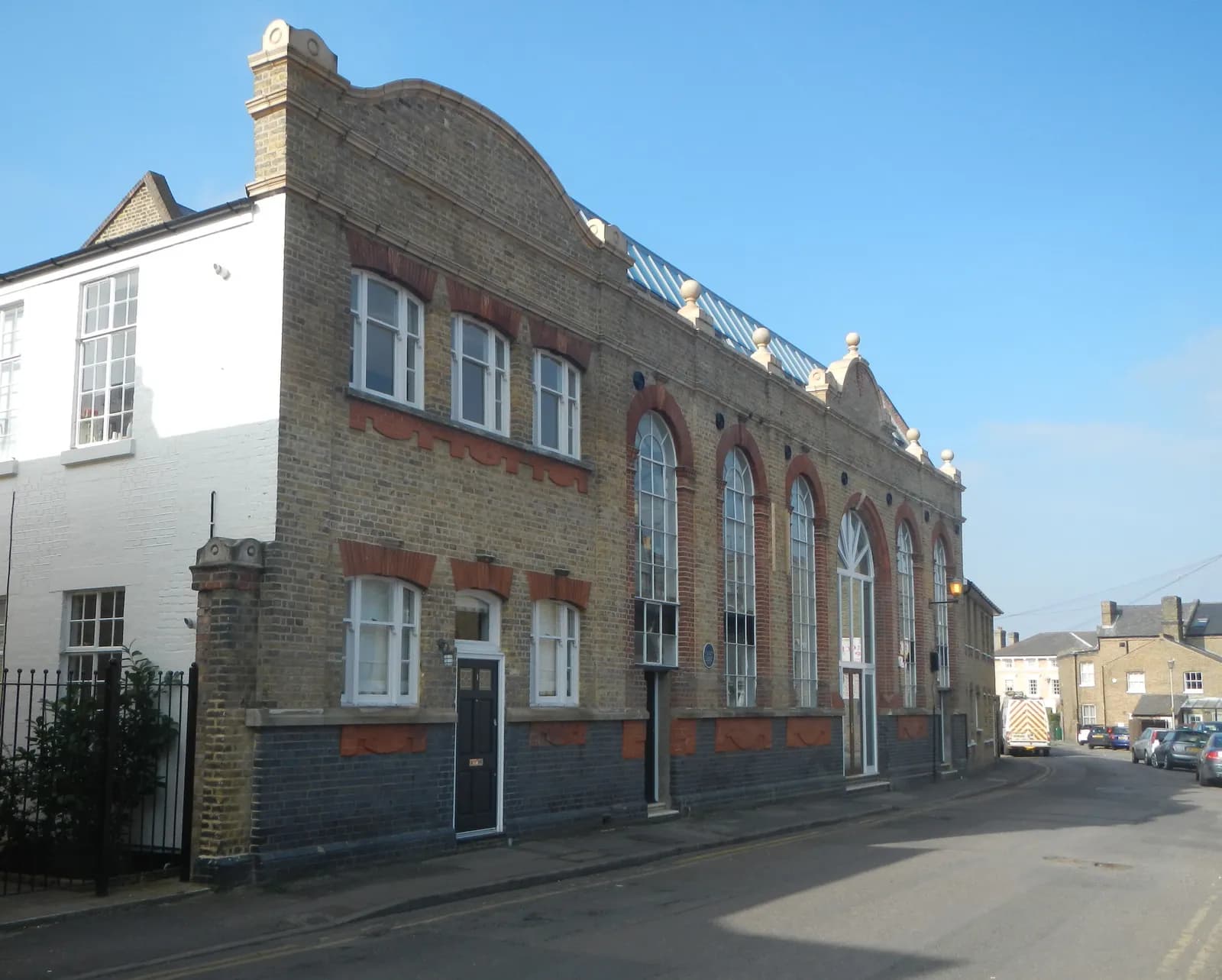
Crompton merged his company with F. & A. Parkinson Ltd in 1927 to form Crompton-Parkinson, though the Writtle Road works continued under the Crompton name for decades. He retired to Yorkshire in 1939 and died on 15 February 1940, aged 94. His legacy in Chelmsford endures in street names—Rookes Crescent, Evelyn Place, and Crompton Street among them—and in the Crompton Building itself, which still stands on Writtle Road. Now housing an NHS surgery, pharmacist, and residential flats, the building retains the original "Crompton" name over its door.
While Marconi's wireless achievements often dominate local memory, Crompton's contribution to Chelmsford's industrial heritage is equally significant. The city was home to one of the world's first large-scale electrical equipment manufacturers, and the standards Crompton helped establish continue to shape how the world uses electricity today.