Long before smartphones and streaming services transformed how we consume media, a quiet Essex market town became the cradle of a technology that would shrink the world. Chelmsford's transformation from agricultural centre to global communications hub began in 1898, when a young Italian inventor established what would become the world's first radio factory.
From Silk Works to Wireless Telegraphy
In 1898, Guglielmo Marconi opened the world's first radio factory on Hall Street in the Moulsham area of Chelmsford. The premises, formerly a silk-works, initially employed approximately 50 people manufacturing maritime wireless telegraphy equipment. This modest operation would prove revolutionary; the SOS equipment produced there played vital roles in rescues from both the Titanic and the Lusitania.
Marconi had arrived in London in 1896, aged 21, seeking support for his wireless experiments. He gained the interest of William Preece, Chief Electrical Engineer of the General Post Office. By 20 July 1897, the Wireless Telegraph and Signal Company was formed, following the granting of a British patent on 2 July 1897.
The Seventeen-Week Factory
Demand for wireless equipment outgrew the Hall Street site rapidly. On 26 February 1912, construction began on a purpose-built factory on New Street, on part of the old Essex County Cricket Club ground. Remarkably, the project took just 17 weeks from conception to completion. The factory opened on 22 June 1912, inaugurated by delegates of the International Radiotelegraphic Conference. The changeover from Hall Street occurred over a single weekend.
The New Street Works, covering 70,000 square feet of production space, is credited as the world's first purpose-built radio factory. Two 450-foot aerial masts were added to the site in 1919. At its peak, the factory employed approximately 4,500 people, fundamentally reshaping Chelmsford's economy and identity.
Melba's Voice Crosses Continents
The New Street Works achieved global recognition on 15 June 1920, when the first official publicised sound broadcast in the United Kingdom took place from the site. Australian soprano Dame Nellie Melba sang two arias and her famous trill; the signal was received throughout Europe and as far away as Newfoundland, Canada. A blue plaque now commemorates this broadcast at the factory site.
This demonstration proved that wireless communication could span continents, transforming public understanding of the technology's potential.
"Two Emma Toc" and the Birth of Broadcasting
While the Melba broadcast was a spectacular one-off, the world's first regular wireless broadcasts for entertainment began on 14 February 1922 from an ex-Army hut at Writtle, near Chelmsford. The station, using the callsign 2MT (pronounced "Two Emma Toc"), transmitted from an ex-Army hut next to Marconi laboratories. Operating at 200 watts on 700 metres, it broadcast on Tuesday evenings from 20:00 to 20:30.
Captain P.P. Eckersley, a Marconi engineer, served as presenter and producer. His opening announcement, "This is Two Emma Toc, Writtle testing," became well-known across Britain. These pioneering broadcasts led directly to the establishment of 2LO in London and, on 18 October 1922, the formation of the British Broadcasting Company, later the BBC.
Part of the original 2MT hut is now preserved at Sandford Mill Museum of Science and Industry in North Chelmsford. An information board at Melba Court in Writtle, unveiled by Guglielmo's daughter Princess Elettra Marconi in 1997, commemorates the site.
A Century of Innovation
Marconi's presence in Chelmsford sparked broader industrial growth. Other major manufacturers were attracted to the town, including R.E.B. Crompton & Co, Hoffmann Ball Bearings, Fell Christy, and others. The Marconi Research Centre at Great Baddow, opened in 1939, employed up to 1,200 engineers at its peak. A 360-foot Chain Home radar tower there, now Grade II listed, is the last remaining tower retaining all platforms.
During the Second World War, both the Marconi factory and Hoffmanns ball bearing factory were key to the war effort. The town suffered accordingly: a Luftwaffe raid on 14 May 1943 killed more than 50 people, and a V-2 rocket strike on Henry Road on 19 December 1944 killed 39.
The Legacy Today
Manufacturing continued at New Street until 2008, ending over a century of continuous radio production in Chelmsford. The Marconi defence division was purchased by British Aerospace in 1999 to form BAE Systems; the Great Baddow site is now BAE Systems Applied Intelligence Laboratories. The New Street Works site was redeveloped by Bellway Homes from 2012, with only the Grade II listed structures retained.
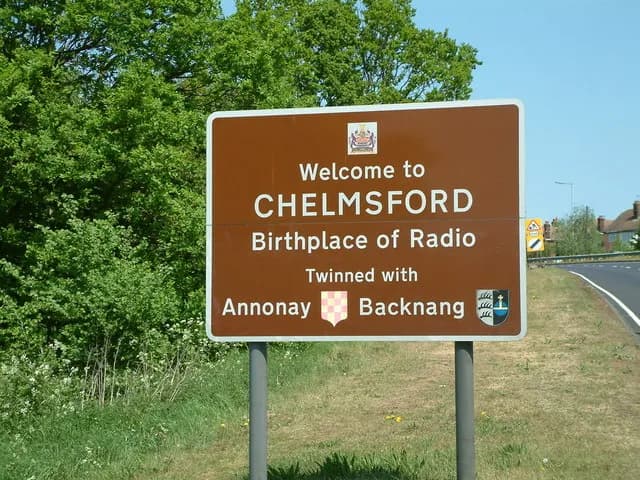
Chelmsford continues to embrace its broadcasting heritage. Road signs entering the city declare it the "Birthplace of Radio." In 2022, the Chelmsford Amateur Radio Society commemorated the 2MT centenary with special callsign GB100-2MT, echoing the pioneering transmissions that began a century earlier from a modest hut on the edge of town.